
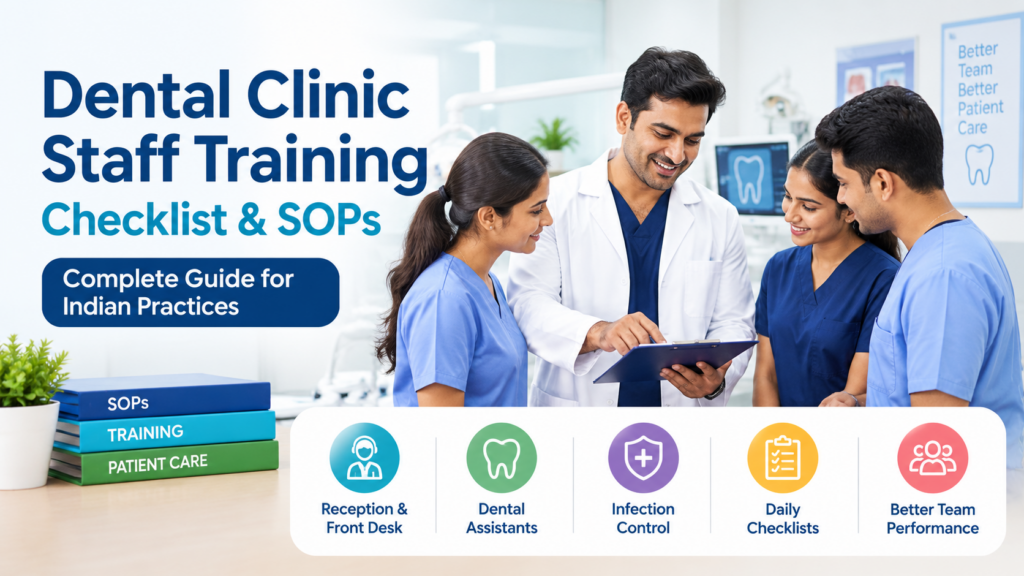
Comprehensive dental clinic staff training is the backbone of an organized, patient-friendly, and profitable dental practice in India. When front-office receptionists and chairside assistants rely on clearly documented Standard Operating Procedures (SOPs) rather than guesswork, everyday clinic operations become smooth and predictable. Implementing structured training protocols eliminates common practice bottlenecks—from mismanaged appointment books and lost patient inquiry calls to sterilization oversights—transforming daily clinical chaos into consistent treatment delivery and long-term practice growth.
Whether you run a single-chair clinic or a multi-chair dental centre, trained receptionists, dental assistants and support staff can help improve patient communication, infection-control practices, appointment management and overall workflow.
This guide shares a practical Dental Clinic Staff Training checklist and SOP framework for Indian dental practices, based on common clinic-management requirements and practical experience.
Why Is Dental Clinic Staff Training Important?
The problem with informal staff training
Many dental clinics train new employees simply by asking them to observe existing staff. This can work initially, but it may result in inconsistent methods for appointment booking, patient communication, sterilisation, billing and follow-up.
A written SOP tells staff what needs to be done, when it needs to be done and who is responsible.
For a growing dental clinic, this becomes increasingly important because the dentist cannot personally supervise every routine task throughout the day.
Retaining patients in Indian dental clinics
Patients often remember more than the treatment itself. Their experience with the receptionist, waiting time, communication and follow-up can influence their overall perception of the clinic.
Well-trained staff can help create a more consistent patient experience through:
- Polite communication
- Accurate appointment scheduling
- Timely reminders
- Clear non-clinical information
- Proper follow-up
- Efficient coordination with the dentist
For more strategies, read our guide on Dental Patient Retention.
Phase 1: Dental Receptionist and Front Desk Staff Training Checklist
Patient calls and appointment booking
Reception staff should be trained to:
- Answer calls professionally.
- Record the patient’s name and contact details.
- Understand the reason for the visit without attempting to diagnose.
- Explain consultation fees and booking policies.
- Schedule appointments accurately.
- Confirm appointments and send reminders.
- Escalate urgent symptoms to the dentist.
Handling “RCT ka kitna kharcha hoga?”
This is a common question in dental practice.
Instead of giving an unsupported fixed price, staff can explain that the cost of root canal treatment may depend on the tooth involved, clinical findings and the restoration required after treatment.
If your clinic has an approved price range, staff can communicate that range clearly while explaining that the dentist will determine the appropriate treatment after examination.
Reception staff should not diagnose the patient or guarantee a final treatment cost without the dentist’s assessment.
Managing UPI deposits and appointment advances
If your clinic collects an appointment advance:
- Clearly communicate the amount.
- Explain whether it will be adjusted against treatment fees.
- Explain cancellation and refund policies.
- Provide a receipt.
- Reconcile UPI transactions with the day’s accounts.
Patient registration and waiting-room management
Reception staff should be trained to:
- Record and update patient information accurately.
- Maintain confidentiality.
- Check whether required forms are completed.
- Inform patients about unexpected delays.
- Coordinate efficiently between reception and the dental operatory.
The goal should be professional communication rather than simply making patients wait quietly.
WhatsApp communication and recall training
With appropriate patient consent, WhatsApp can be useful for appointment confirmation, reminders and follow-ups.
Hinglish recall script:
“Namaste, aapka dental check-up due hai. Kya hum aapke liye appointment schedule karein?”
English recall script:
“Hello, your dental check-up is due. Would you like us to schedule an appointment?”
For clinics looking to organise patient communication and reminders, see our guide on WhatsApp Automation for Dental Clinics.
Phase 2: Dental Assistant Training Checklist and SOPs
Four-handed dentistry and chairside assistance
Dental assistants should be trained to:
- Identify commonly used instruments.
- Prepare procedure-specific trays.
- Understand the dentist’s preferred instrument arrangement.
- Recognise agreed hand signals.
- Assist with suction and retraction appropriately.
- Maintain an organised working field.
- Follow hand hygiene and PPE protocols.
- Follow sharps-safety procedures.
Procedure-wise tray preparation
| Procedure | Training checklist |
|---|---|
| Root canal treatment | Endodontic instruments, files, irrigation supplies and isolation equipment |
| Composite restoration | Examination instruments, restorative materials and matrix system where indicated |
| Impression taking | Correct tray, measured material and manufacturer-recommended mixing |
| Oral surgery/implant procedure | Procedure-specific sterile instruments, drapes and required components |
Assistants should work only within their qualifications, training and legally permitted responsibilities.
Phase 3: Sterilisation and Biomedical Waste Management
Instrument cleaning and autoclave SOP
A written instrument-reprocessing workflow should include:
- Safe transportation of used instruments.
- Cleaning using an appropriate validated method.
- Instrument inspection and drying.
- Proper pouching and sealing.
- Appropriate autoclave cycle according to equipment instructions.
- Review and documentation of cycle parameters and indicators.
- Safe storage of sterile packs.
If sterilisation fails or a sterile package becomes compromised, it should not be used for patient care- that’s why dental clinic staff training is very important.
Operatory turnover checklist
After every patient:
- Segregate waste correctly.
- Remove contaminated barriers safely.
- Clean and disinfect clinical contact surfaces.
- Send reusable instruments for reprocessing.
- Replace necessary barriers and supplies.
- Prepare the operatory for the next patient.
A clinic can establish a reasonable turnover target, but speed should never take priority over infection-control procedures.
Indian biomedical waste segregation
Dental staff should be trained according to applicable Biomedical Waste Management Rules, state requirements and the procedures followed by the authorised waste-collection provider.
| Colour category | Typical examples |
|---|---|
| Yellow | Specified anatomical waste and blood-soiled waste |
| Red | Specified contaminated recyclable plastic waste |
| White (translucent) | Contaminated sharps in puncture-proof containers |
| Blue | Specified contaminated glassware and metallic implants |
Waste should be segregated at the point where it is generated.
Phase 4: Daily Opening, Closing and Financial Reconciliation
Morning opening checklist
A short morning huddle can help the entire team understand the day’s priorities.
Review:
- Today’s appointments.
- Pending treatment cases.
- Follow-up patients.
- Expected emergencies.
- Laboratory cases.
- Staff attendance.
- Operatory readiness.
- Sterilisation status.
- Essential materials.
- Emergency equipment.
End-of-day closing checklist
Staff should:
- Clean and disinfect clinical areas.
- Process instruments.
- Store sterile packs correctly.
- Maintain suction systems according to manufacturer instructions.
- Check equipment according to established maintenance procedures.
- Reconcile cash.
- Reconcile card payments.
- Reconcile UPI transactions.
- Verify billing records.
- Secure patient records and clinical materials.
Medical emergency preparedness
Every member of the dental team should know:
- Who to call during an emergency.
- Where the emergency kit is located.
- How to summon emergency medical services.
- Their role during an emergency.
- Basic life-support procedures appropriate to their training.
Conduct periodic emergency drills rather than assuming staff will automatically know what to do.
Phase 5: Patient Data Privacy and Record Management
Dental clinic staff regularly handle personal and medical information.
Training should include:
- Restricting access to authorised personnel.
- Avoiding patient discussions in public areas.
- Appropriate consent for clinical photographs.
- Safe handling of patient reports.
- Secure use of clinic software.
- Password and account security.
- Appropriate communication through digital platforms.
Create a simple written policy explaining who can access patient information and how records should be handled.
Phase 6: Dental Staff Competency Assessment
Staff training should not end after someone has watched another employee perform a task.
Use a simple competency assessment.
| Skill | Observation | Supervised practice | Competent |
|---|---|---|---|
| Appointment booking | ✓ | ✓ | ✓ |
| Patient communication | ✓ | ✓ | ✓ |
| Instrument identification | ✓ | ✓ | ✓ |
| Tray preparation | ✓ | ✓ | ✓ |
| Sterilisation workflow | ✓ | ✓ | ✓ |
| Biomedical waste segregation | ✓ | ✓ | ✓ |
| Billing/UPI reconciliation | ✓ | ✓ | ✓ |
| Emergency response | ✓ | ✓ | ✓ |
The supervising dentist or designated trainer should document the assessment and identify areas requiring additional training.
The 14-Day Dental Clinic Staff Training Plan
Week 1: Observation and essential skills
Days 1–3: Clinic rules, patient communication, privacy, hand hygiene and waste segregation.
Days 4–7: Appointment booking, instrument identification, sterilisation observation and supervised reception duties.
Week 2: Supervised practice and assessment
Days 8–10: Chairside assistance, tray preparation and operatory turnover.
Days 11–12: Billing, appointment reminders, recall lists and clinic software.
Days 13–14: Practical competency assessment, feedback and supervisor sign-off.
The 14-day framework is an initial onboarding plan, not a guarantee that an employee will become independently competent in every responsibility. Continue supervision until the required skills are demonstrated consistently.
Suggestions From a Dental Clinic Owner
Practical lessons from 12+ years of dental practice
As a BDS dentist with 12+ years of clinical experience and the owner of two dental clinics, I have found that staff management becomes much easier when routine responsibilities are converted into simple, repeatable systems.
Here are some practical suggestions for dentists starting or growing their clinics:
1. Don’t depend entirely on verbal instructions.
If a task is performed regularly, create a simple written SOP for it.
2. Start with the five most important SOPs.
If you have no formal system, begin with appointment booking, sterilisation, chairside setup, patient follow-up and daily closing.
3. Give every important task an owner.
A checklist is more effective when one person is responsible for completing and checking it.
4. Train staff to communicate professionally, not to pressure patients.
Staff can explain appointment procedures and administrative information. Clinical diagnosis, treatment alternatives, risks and benefits should remain the responsibility of the dentist.
5. Conduct short monthly reviews.
You do not always need a long meeting. Review punctuality, documentation, sterilisation compliance, patient feedback and follow-up completion.
6. Correct mistakes through training.
If the same mistake occurs repeatedly, ask whether the SOP or training process needs improvement rather than simply blaming the staff member.
7. Keep a staff training record.
Record the training date, topic, trainer, competency assessment and any retraining required.
8. Build systems before your clinic becomes too busy.
When patient volume increases, informal systems become harder to manage. Documenting workflows early can make expansion to additional chairs or staff easier.
How Dental Clinic Staff Training Supports Practice Growth
Staff training is only one part of running a successful dental practice. Patient communication, treatment acceptance, retention, online visibility, branding and operational systems also matter.
At DentalClinicAlly, our Dental Clinic Growth Services are designed to help dentists work towards a more organised and sustainable practice.
For dentists who want to strengthen their professional presence and communicate their expertise online, explore our Dentist Brand Development Services.
Conclusion
Effective Dental Clinic Staff Training is not simply about teaching an assistant how to pass instruments or teaching a receptionist how to book appointments. It is about building a consistent system for patient communication, infection control, chairside assistance, documentation and daily clinic operations.
As a dentist and owner of two dental clinics, my recommendation is to start small: document the routine tasks, train staff using those SOPs, assess competency and review the system regularly.
A well-trained team allows the dentist to spend more time focusing on clinical care while routine operations become more organised and predictable.
Frequently Asked Questions
How long does it take to train an untrained dental assistant?
A structured 14-day onboarding programme can introduce essential clinic workflows and basic operatory setups. However, chairside assistance, infection control protocols, and emergency preparedness require continuous supervised practice and structured competency assessment.
If you want a complete, step-by-step system to streamline staff onboarding and scale operations, explore our Dental Clinic Growth Plan.
What should a dental clinic staff training checklist include?
A comprehensive checklist should cover front desk reception, appointment scheduling, patient communication, patient data privacy, chairside assisting, autoclave sterilisation, biomedical waste management (BMW guidelines), emergency preparedness, billing reconciliation, and daily opening and closing SOPs.
What is the most important SOP for a dental receptionist?
Accurate appointment scheduling and phone inquiry triage are the most critical components. This includes professional communication, confidential patient record handling, transparent administrative fee guidance, and prompt escalation of urgent dental symptoms to the dentist.
How can trained staff reduce dental treatment dropouts?
Staff reduce dropouts by mandating chairside booking for the next appointment before the patient departs, dispatching automated reminders, and communicating patient concerns to the dentist so clinical and financial questions are resolved immediately.
Learn practical communication workflows in our complete guide to dental patient retention.
How often should dental clinic staff receive training?
Clinics should provide initial structured onboarding, periodic quarterly refresher training, and immediate sessions whenever SOPs change, new clinical equipment is introduced, or modern tools are integrated—such as setting up WhatsApp automation for dental clinics for automated patient recalls.
How can I measure dental staff training effectiveness?
Track measurable KPIs such as practical competency assessments, autoclave sterilisation spore testing audits, documentation accuracy, staff punctuality, patient review sentiment, and recall appointment conversion rates.
Can an unqualified dental assistant perform dental procedures independently?
No. Clinic staff must strictly operate within their formal qualifications and legally permitted non-clinical scope. Clinical diagnoses, irreversible cavity preparations, and procedures requiring a registered dental practitioner must never be delegated to unqualified personnel.

Dentist | Private Practitioner | Dental Clinic Owner | Dental Practice Consultant
Dr. Anuran Ghosh Mondal is a BDS-qualified dentist, private practitioner and dental clinic owner with 12+ years of clinical experience in India. He is the founder of DentalClinicAlly.com and DentistUpgrade.com and has practical experience in Dental Clinic Business Consulting- dental practice management, patient acquisition, market analysis, branding, marketing and clinic growth.