
Choosing the right dental clinic management software is an important decision for dentists who want to improve clinical efficiency, manage appointments, maintain patient records and grow their practice. As dental clinics in India become more competitive, relying entirely on paper registers and spreadsheets can create administrative difficulties and affect patient experience.
Modern dental software helps manage treatment records, digital prescriptions, billing, appointments, follow-ups and patient communication from one platform. However, not every software offers the same features, pricing or security.
In this guide, we will explain how to select the right dental clinic management software for your practice, what features to evaluate and what Indian dentists should consider before investing.
Why Manual Registers and Generic Spreadsheets Fail Growing Practices
The Problems with Paper-Based Record Keeping
Paper-based records may work for a small practice initially, but managing hundreds or thousands of patient files becomes difficult over time.
Lost Case Sheets and Missing Follow-up Histories: Finding previous treatment records, prescriptions and follow-up details can become time-consuming. Missing information may affect treatment continuity.
Physical Storage and Retrieval Delays: Maintaining physical files requires storage space. Retrieving old radiographs, treatment histories and consent forms can delay clinical workflows.
Why Standard Spreadsheets Are Not Enough
Spreadsheets can help with basic accounting and patient lists, but they are not designed specifically for dentistry.
They generally lack:
- FDI dental notation and interactive tooth charting.
- Periodontal charting and treatment planning.
- Direct integration with RVG and dental imaging systems.
- Clinical prescription templates.
- Digital consent forms and treatment histories.
A dedicated dental clinic management software platform offers more dentistry-specific functionality.
Core Features to Look for in Modern Dental Software
Before purchasing any software, identify the features that will genuinely improve your clinic’s daily operations.
1. Chairside Clinical Workflow Management
Interactive Tooth Charting and Treatment Planning
Look for software that supports FDI tooth numbering, visual tooth charting and documentation of restorative, endodontic, periodontal and prosthetic conditions.
It should allow dentists to:
- Record existing dental conditions.
- Prepare treatment plans.
- Track completed and pending procedures.
- Generate treatment-wise cost estimates.
- Present phased treatment plans to patients.
Imaging and Radiograph Management
The software should support linking RVG images, intraoral photographs and other dental radiographs with individual patient records. Check compatibility with your existing imaging equipment and DICOM workflows.
Before-and-after clinical photographs can also help document treatment progress, subject to appropriate patient consent.
Digital Prescriptions and Clinical Notes
Prescription templates, editable clinical notes, drug information and digital consent documentation can reduce repetitive administrative work. Ensure prescriptions can be reviewed and authenticated by the treating dentist.
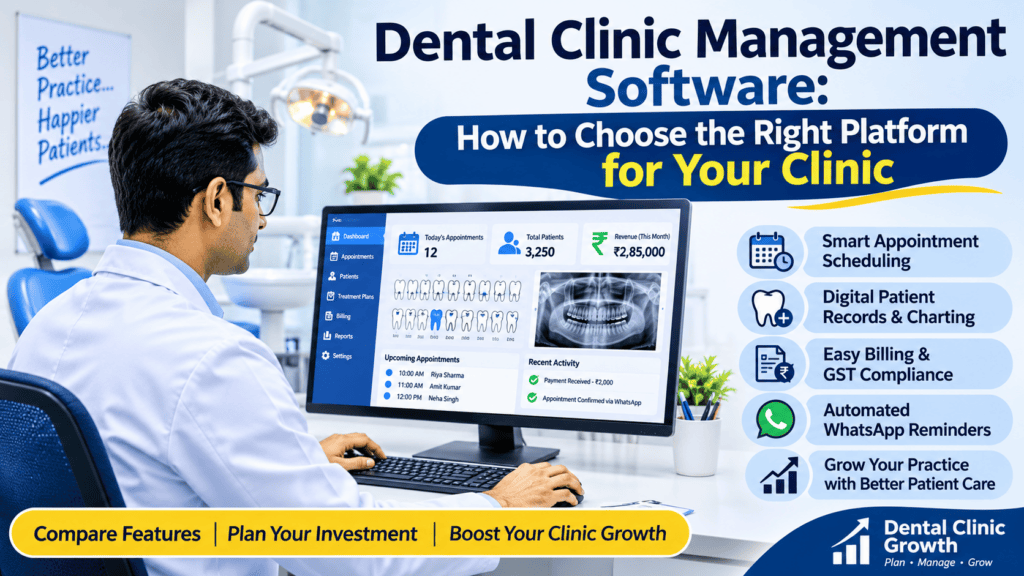
2. Appointment Scheduling and Patient Retention
Appointment management is one of the most useful features of dental practice management software.
Look for:
- Doctor-wise and chair-wise appointment calendars.
- Automated appointment confirmations.
- Patient recall and follow-up reminders.
- Waiting-list and queue management.
- Cancellation and rescheduling management.
- Hygiene and periodic review reminders.
Automated SMS and WhatsApp reminders can help reduce missed appointments.
Research on patient reminders and notifications is available through the Agency for Healthcare Research and Quality (AHRQ).
For additional strategies, read our guide on Dental Patient Retention.
3. Automated Patient Communication
Modern dental software may offer WhatsApp integration, SMS notifications and automated communication workflows.
Useful functions include:
- Appointment booking confirmations.
- Upcoming appointment reminders.
- Post-treatment follow-ups.
- Recall notifications.
- Payment reminders.
Check whether WhatsApp integration uses the official WhatsApp Business Platform and whether additional API or messaging charges apply.
Learn more about WhatsApp Automation for Dental Clinics.
4. Financial Management, Billing and GST
Financial management is essential for running a profitable dental practice.
Check whether the software offers:
- Patient-wise billing and digital receipts.
- Treatment-wise cost tracking.
- GST-compatible invoicing where applicable.
- UPI, cash, card and bank payment records.
- Outstanding payment tracking.
- Doctor-wise revenue reports.
- Daily, monthly and annual financial reports.
For implant cases, orthodontics and other long-duration treatments, staggered payment tracking can be particularly useful.
5. Staff Management and Reporting
A growing clinic needs proper coordination between receptionists, dental assistants and dentists.
Role-based access, staff activity records, appointment allocation and performance reports can improve accountability.
However, software alone cannot replace proper staff training. Read our guide on Dental Clinic Staff Training.
Cloud-Based vs Offline Desktop Dental Software
One important decision is choosing between cloud-based and locally installed software.
Cloud-Based Dental Clinic Software
Cloud-based systems store data on remote servers and allow authorised users to access information through the internet.
Advantages:
- Access records from different locations.
- Manage multiple clinic branches.
- Synchronise appointments and patient records.
- Automated cloud backup options.
- Reduced dependence on a single clinic computer.
What to Check: Internet connectivity is important. Ask whether the software supports offline access or temporary local data caching during internet outages.
Offline Desktop Software
Desktop software stores patient information on local clinic computers or servers.
Advantages:
- Can operate without continuous internet access.
- Local control over hardware and storage.
- May offer a one-time licensing option.
Limitations:
- Manual backup responsibilities.
- Hardware failure risks.
- Additional maintenance requirements.
- Remote access may require extra configuration.
For a clinic planning multiple branches, cloud-based software may offer greater flexibility. However, security, backup and data ownership should always be evaluated.
Dental Software Pricing: Subscription vs Lifetime License
The cheapest software is not necessarily the most economical option.
SaaS Subscription Model
Software-as-a-Service platforms generally charge monthly or annually.
Pricing may depend on:
- Number of doctors or chairs.
- Number of clinic locations.
- Storage requirements.
- Communication integrations.
- Advanced reporting features.
Updates, technical support and cloud hosting may be included depending on the plan.
One-Time Lifetime License
Some providers offer a one-time purchase option.
However, check whether annual maintenance charges, upgrades, technical support and backup services require additional payments.
Hidden Costs to Consider
Before purchasing, ask about:
- WhatsApp Business API and messaging charges.
- Additional cloud storage for radiographs.
- Data migration and onboarding fees.
- Additional doctor or branch licensing.
- Annual maintenance charges.
- Cancellation and data export fees.
Always request a complete written quotation before making a decision.
Medicolegal Compliance, Data Ownership and Patient Privacy in India
Patient records contain confidential clinical and personal information. Therefore, data security should be a priority when selecting dental clinic management software.
Clinical Record Maintenance
The Dental Council of India’s Revised Dentists Code of Ethics provides for maintaining relevant outpatient and inpatient records for a minimum of three years from the commencement of treatment. It also addresses providing records to patients or authorised authorities within 72 hours of a valid request.
Read the Dental Council Code of Ethics reference.
Your software should support:
- Secure patient record storage.
- Access permissions for different staff members.
- Reliable backups.
- Treatment history and audit trails.
- Easy retrieval and export of clinical records.
DPDP Act and Patient Data Protection
The Digital Personal Data Protection Act, 2023 and DPDP Rules, 2025 establish India’s framework for digital personal data protection, with phased implementation timelines.
Dentists should evaluate whether their software supports appropriate consent notices, secure data handling, access controls and safeguards against unauthorised access.
Ask the vendor about encryption, server location, backup policies, breach notification procedures and data deletion arrangements.
Also consider the National Health Systems Resource Centre’s medico-legal guidelines.
Who Owns Your Patient Data?
This is one of the most important questions to ask a software provider.
Before purchasing, confirm:
- You can export patient records in usable formats such as CSV or PDF.
- Clinical images can be downloaded in their original supported formats.
- You can retrieve your complete data if you discontinue the service.
- The vendor has a documented data migration policy.
- There are no unreasonable vendor exit penalties.
Never assume that paying for software automatically gives you unrestricted access to all your clinic data.
Need Help Growing Your Dental Clinic?
Choosing the right software is only one step towards building a successful dental practice. Many dentists invest heavily in clinical equipment and technology but still struggle with patient acquisition, treatment acceptance, clinic branding, staff management, and business planning.
DentalClinicAlly provides specialized Dental Clinic Growth Services to help dental practitioners establish, run, and scale structured practices through proven, data-driven frameworks.
Our Practice Growth Consulting Covers:
-
Practice Audit & Business Strategy: Comprehensive clinic business analysis followed by custom business planning and structured roadmap execution.
-
Clinic Branding & Online Footprint: Establishing market authority, Google local presence, and professional credibility in your micro-market.
-
Patient Acquisition & Digital Marketing: Ethical, sustainable digital marketing guidance to generate reliable patient inquiries without predatory ad spend.
-
Patient Retention & Communication: Structured recall systems, treatment presentation guidance, and patient satisfaction workflows.
-
Practice Development & Operations: Optimizing daily operational workflows, staff accountability, and patient journey efficiency.
If you want to build a more organized, visible, and growth-oriented dental practice, take the next step.
Explore Dental Clinic Growth Services →Step-by-Step Implementation Without Disrupting Clinic Operations
Switching from registers to digital management requires proper planning.
Phase 1: Data Cleaning and Patient Migration
Organise existing patient information, remove duplicate entries and prioritise active patient records. Verify important treatment histories before migration.
Phase 2: Staff Training
Train receptionists and dental assistants in appointment booking, billing, patient registration and follow-up management. Dentists should learn clinical charting, prescriptions and treatment documentation.
Phase 3: Parallel Run
For approximately 14 days, consider maintaining both the existing register system and the new software. Check appointment accuracy, billing records and patient histories before completely switching to digital records.
Final Thoughts: Choose Software That Supports Your Clinic’s Growth
The right dental clinic management software should do more than store patient information. It should improve clinical documentation, simplify appointments, support financial tracking and help maintain long-term patient relationships.
Before purchasing, compare at least two or three providers, request live demonstrations and test the most important features using sample patient records.
Remember, technology is only one part of building a successful dental practice. Proper business planning, patient communication, staff training and effective marketing are equally important.
Frequently Asked Questions
Can one dental clinic management software manage multiple branches?
Yes. Many modern platforms support multiple locations, doctor-wise scheduling, centralised reporting and branch-wise financial tracking. Confirm the number of branches included in the selected subscription.
Is cloud dental software safe for storing patient X-rays?
Cloud storage can be secure when appropriate encryption, access controls, backups and security practices are implemented. However, security depends on the provider’s actual infrastructure and policies. Always verify these before uploading clinical images.
What is the monthly cost of dental software for a solo clinic in India?
Pricing varies depending on the provider, features, storage and licensing model. Basic systems may be relatively affordable, while advanced platforms with imaging, automation and multi-branch support generally cost more. Request a complete quotation and compare the total annual cost.
Can I send digital prescriptions through WhatsApp?
Dentists may use electronic communication to share prescriptions, provided applicable professional, prescription and data-protection requirements are followed. Ensure the prescription is properly authenticated, patient privacy is protected and appropriate records are maintained. WhatsApp delivery does not itself establish legal validity.
What happens if I change my dental software provider?
You should be able to retrieve your clinic’s records according to your contractual and applicable legal rights. Before signing up, confirm the available export formats, migration support, backup arrangements and exit charges.

Dentist | Private Practitioner | Dental Clinic Owner | Dental Practice Consultant
Dr. Anuran Ghosh Mondal is a BDS-qualified dentist, private practitioner and dental clinic owner with 12+ years of clinical experience in India. He is the founder of DentalClinicAlly.com and DentistUpgrade.com and has practical experience in Dental Clinic Business Consulting- dental practice management, patient acquisition, market analysis, branding, marketing and clinic growth.