
A dental clinic business plan helps Indian dentists evaluate market demand, estimate investment, understand legal requirements, and build a financially sustainable practice. Whether you are opening your first clinic after BDS or expanding an existing practice, a structured plan helps reduce financial risks and establish realistic business goals. It should cover market feasibility, financial projections, regulatory compliance, infrastructure, funding, and patient acquisition.
1. Executive Summary & Market Feasibility for Indian Dentists
Begin by defining your target location, proposed treatments, investment capacity, target patients, and expected revenue. Research the local market before committing to a property or purchasing equipment.
Defining Your Practice Model: Solo OP, Polyclinic, or Specialty Studio
Choose a model that matches your experience, budget, and local demand.
- Solo dental clinic: Suitable for dentists starting independently with essential equipment.
- Multispecialty polyclinic: Offers services through visiting specialists in orthodontics, endodontics, periodontics, and oral surgery.
- Specialty dental studio: Focuses on implants, aligners, cosmetic dentistry, or pediatric dentistry.
Starting with essential equipment and visiting specialists can help first-time owners control expenses.
Catchment Area Demographics & Competitor Density Analysis
Study the surrounding population, household income, residential density, accessibility, and demand for dental treatments. Compare nearby clinics, consultation fees, services, patient reviews, and opening hours.
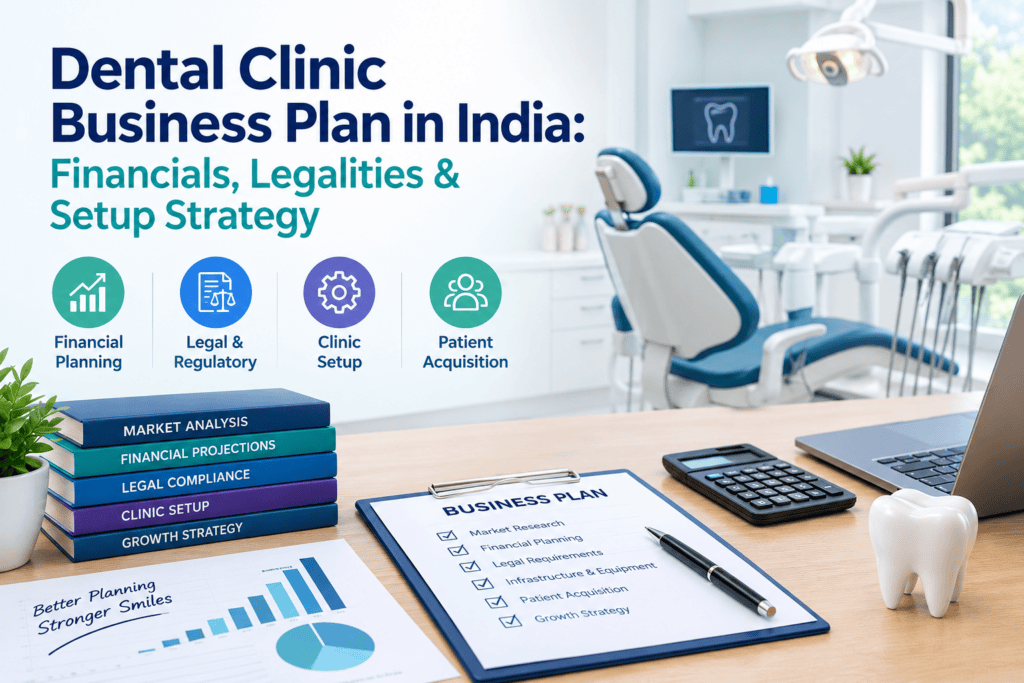
Evaluating Footfall vs. Rental Costs in Tier-1, Tier-2, and Tier-3 Cities
Tier-1 cities may offer higher patient spending potential but often have greater rent and competition. Tier-2 and Tier-3 locations may have lower overheads, although demand varies by locality.
Check visibility, parking, public transport, and accessibility. Inspect the property during the rainy season, if possible, to identify waterlogging and drainage problems.
For professional guidance on feasibility, vendor quotations, and investment planning, explore our dental clinic setup cost in India advisory service.
2. Core Legal & Regulatory Framework in India
Requirements vary by state, municipality, clinic services, and equipment. Confirm applicable rules with the relevant authorities before opening your practice.
State Dental Council Registration & Good Standing Certificates
Maintain valid registration with the relevant State Dental Council and keep your qualifications and professional documents updated. Verify the registration status of any additional dentists working at your clinic.
Clinical Establishments (Registration and Regulation) Act Compliance
Check whether the Clinical Establishments Act applies in your state or union territory, or whether separate state legislation governs registration.
Visit the Clinical Establishments official portal and consult your local health authority about applicable registration requirements.
AERB Approval Workflow for Intraoral Dental X-Ray & OPG Machines
For intraoral X-ray and OPG equipment, check the applicable Atomic Energy Regulatory Board (AERB) requirements. Registration, equipment approval, radiation-safety measures, and installation compliance may apply depending on the equipment and circumstances.
Refer to the AERB e-LORA regulatory portal and plan radiation shielding and installation with qualified professionals.
Bio-Medical Waste Management Authorization & PCB Clearances
Dental clinics generate biomedical waste, including contaminated materials, sharps, and extracted teeth. Follow applicable segregation, storage, handling, and disposal requirements, and arrange collection through an authorized common biomedical waste treatment facility where required.
Check authorization requirements with your State Pollution Control Board or Pollution Control Committee. Refer to the Central Pollution Control Board’s biomedical waste rules.
Local Municipal Trade License & Fire Safety NOC
Confirm applicable municipal trade licenses, building-use permissions, signage regulations, and fire-safety requirements. Eligible businesses can also explore Udyam Registration and verify the current MSME eligibility criteria.
3. Practice Financial Planning: Budgeting & Break-Even Modeling
A sound financial plan separates initial investment from recurring expenses and estimates how much working capital the clinic needs before patient flow stabilizes.
Capital Expenditure (CapEx) vs. Operating Expenditure (OpEx) Overview
Capital expenditure (CapEx) includes dental chairs, compressors, sterilization equipment, instruments, furniture, renovation, electrical work, and essential technology.
Operating expenditure (OpEx) includes rent, salaries, consumables, laboratory bills, electricity, software, equipment maintenance, biomedical waste collection, and marketing.
Obtain itemized quotations from multiple vendors and compare specifications, installation, warranty, servicing, and taxes. For a detailed equipment-pricing review and setup guidance, visit our dental clinic setup cost in India service page.
Estimating Month-1 to Month-12 Operating Working Capital
Forecast expenses and collections for the first 12 months using conservative, expected, and optimistic scenarios. Maintain a reserve for unexpected repairs, slower patient acquisition, and delayed collections. Keep personal and clinic finances separate.
Fixed Monthly Overheads: Rent, Staff Salaries, Lab Bills, and Utilities
Include rent, maintenance, electricity, staff salaries, dental materials, laboratory charges, software, equipment servicing, accounting, marketing, and applicable taxes or license renewals. Classify expenses as fixed or variable and review actual spending monthly.
Sample Monthly Financial Projection
Consider this illustrative example for a small dental clinic after operations begin stabilizing:
| Financial item | Example amount |
|---|---|
| Monthly patient visits | 200 |
| Average collected revenue per visit | ₹1,000 |
| Total monthly collections | ₹2,00,000 |
| Monthly operating expenses | ₹1,50,000 |
| Operating surplus before financing and tax adjustments | ₹50,000 |
These figures are examples, not industry averages or guaranteed outcomes. Actual results depend on location, treatment mix, discounts, laboratory expenses, collections, and staffing. Include the owner’s remuneration, loan repayments, depreciation, and taxes when evaluating the clinic’s overall financial performance.
Break-Even Calculation: Average Revenue Per Chair vs. Chair Utilization Rate
Break-even is the point at which revenue covers operating costs.
Break-even revenue = Fixed monthly costs ÷ Contribution margin ratio
For example, with fixed monthly costs of ₹1,00,000 and a contribution margin ratio of 60%, the clinic needs approximately ₹1,66,667 in monthly revenue to cover fixed costs, assuming the margin accurately reflects variable expenses.
Estimate patient visits using clinic capacity, operating days, chair utilization, average collected revenue, and treatment mix. Remember that billed revenue and actual collections can differ.
Funding Options for Starting a Dental Clinic in India
Possible funding sources include personal savings, bank term loans, equipment financing, and working-capital facilities. Eligible entrepreneurs may investigate applicable government-supported lending schemes.
Compare interest rates, collateral requirements, repayment schedules, processing fees, and eligibility before borrowing. Avoid taking on excessive debt before validating local demand and expected cash flow.
4. Infrastructure & Clinical Workflow Architecture
Space Optimization Guidelines (250–500 sq. ft.)
A compact clinic may use approximately 250–500 square feet, depending on the number of chairs, services, accessibility, layout, and applicable standards. This is a planning range, not a universal legal minimum.
Plan treatment, reception, sterilization, and storage areas before finalizing a property. Read our guide to dental clinic floor plan and layout for space-planning considerations.
Sterilization Zone Layout: Maintaining Unidirectional Clean-to-Dirty Flow
Separate contaminated instruments from cleaned, packaged, and sterilized instruments. Establish clear workflows for receiving, cleaning, packaging, sterilization, and storage. Provide appropriate handwashing facilities, sharps disposal, surface disinfection, and infection-control documentation.
Essential Machinery Allocation: Base Setup vs. Future Expansion
Prioritize a reliable dental chair, compressor, suction, sterilization equipment, handpieces, diagnostic instruments, and essential digital systems. Add advanced imaging and specialized technologies when clinical demand, regulatory compliance, and financial capacity justify the investment.
5. Patient Acquisition & Revenue Strategy
Local Search Optimization: Google Business Profile & Hyperlocal SEO
Maintain an accurate Google Business Profile with correct contact details, opening hours, services, and location. Publish useful dental education content, develop relevant treatment pages, and encourage genuine patient reviews without pressure.
Explore our dental clinic growth services for additional practice-development support.
Ethical Referral Networks & Community Screening Camps
Build professional relationships with local healthcare providers and community organizations where appropriate. Educational screening camps can improve oral-health awareness. Obtain consent, protect patient confidentiality, and avoid misleading claims or inappropriate referral inducements.
Digital Record Management & Patient Recall Systems
Use a secure patient-management system for clinical records, consent forms, treatment plans, and appointment reminders. Explain treatment options, costs, risks, and alternatives clearly. Recall systems can support preventive care and continuity of treatment.
For a broader patient acquisition strategy, read our ultimate dental practice marketing plan.
6. Dental Clinic Opening Checklist and 90-Day Roadmap
Use this checklist to organize your launch:
- Days 1–30: Research the local market, assess competitors, shortlist properties, and prepare financial projections.
- Days 31–60: Confirm property suitability, verify applicable approvals, finalize quotations, plan interiors, and recruit staff.
- Days 61–90: Complete installation, arrange waste-management procedures, verify compliance, test equipment, prepare patient records, and organize launch marketing.
This is an illustrative timeline. Construction, equipment delivery, and regulatory approvals may require additional time. Do not begin regulated activities before obtaining the required approvals.
7. Common Business Plan Pitfalls Indian Dentists Must Avoid
Underestimating Working Capital & Cash Runway
Spending most available funds on interiors and equipment can leave insufficient money for salaries, rent, consumables, and marketing. Maintain a realistic cash-flow forecast and contingency reserve, and review collections regularly.
Over-Investing in Advanced Tech Before Stabilizing Chair Occupancy
CBCT machines, dental lasers, and premium digital systems can be useful when supported by appropriate demand. Start with equipment suited to your core services and evaluate future purchases based on utilization, maintenance, financing costs, and expected additional revenue.
Conclusion: Build a Sustainable Dental Clinic Business Plan
A successful dental clinic business plan combines market research, legal compliance, financial projections, efficient infrastructure, and ethical patient acquisition. Before committing to a property or equipment purchase, validate demand, estimate first-year working capital, compare funding options, and confirm the requirements applicable to your clinic.
Start with a manageable practice model, monitor financial performance, and expand when patient demand and cash flow support the next stage. Careful planning can help Indian dentists build a clinically reliable and financially sustainable practice.
Frequently Asked Questions: Dental Clinic Business Plan in India
What is the primary purpose of a dental clinic business plan in India?
A dental clinic business plan serves as an operational and financial roadmap. It outlines initial capital allocation, statutory legal compliances (Clinical Establishments Act, AERB, BMW rules), target patient demographics, pricing strategy, and the expected timeline to achieve operational break-even. It is also required when applying for medical professional loans through banks or NBFCs.
What legal licenses are mandatory to open a dental clinic in India?
To operate legally in India, a dentist must have an active State Dental Council registration, Clinical Establishments Act registration (or state-specific nursing home act license), Bio-Medical Waste management authorization from the State Pollution Control Board, AERB (Atomic Energy Regulatory Board) approval via the e-LORA portal for diagnostic X-ray units, and a local Municipal Trade License.
How long does it typically take for a new dental clinic in India to break even?
Most standalone single-chair dental clinics in India achieve operational break-even (covering monthly rent, staff, materials, and utilities) within 4 to 8 months, provided they maintain consistent local outreach. Full capital break-even (recovering initial CapEx investment) typically takes 18 to 36 months, depending on location, treatment mix, and chair occupancy rates.
How much working capital reserve should an Indian dentist keep when launching?
Beyond initial infrastructure and equipment costs, dentists should maintain a minimum working capital reserve covering 4 to 6 months of operating expenses (OpEx). This covers rent, dental assistant salaries, lab bills, utilities, and marketing during the initial low-volume launch phase.
Can I get a bank loan in India to fund my dental clinic setup?
Yes. Most major nationalized and private Indian banks (such as SBI, HDFC, and ICICI) offer specialized Doctor Loans or Professional Practice Loans. Securing these loans requires a detailed business plan showing projected revenues, BDS/MDS degree certificates, State Dental Council registration, and property lease or ownership documentation.

Dentist | Private Practitioner | Dental Clinic Owner | Dental Practice Consultant
Dr. Anuran Ghosh Mondal is a BDS-qualified dentist, private practitioner and dental clinic owner with 12+ years of clinical experience in India. He is the founder of DentalClinicAlly.com and DentistUpgrade.com and has practical experience in Dental Clinic Business Consulting- dental practice management, patient acquisition, market analysis, branding, marketing and clinic growth.